
Reviewed · SELF-GUIDED TOURS
Self-Guided Tour of Ísafjörður: Art, History, and Architecture
Ísafjörður’s fishing story reaches from old boats and brave seafarers to Kerecis, the town’s unusual biotech company known as Iceland’s only unicorn. This self-guided walk connects that past with modern art, odd local details, and a floating-looking crosswalk. I like the local voice and the freedom to pause, wander, or go inside places along the way. I also like the price: $9.99 gives you a useful introduction to town without tying you to a group schedule.
The main catch is the technology. You need your own phone and headphones, and the VoiceMap app may take a little work to set up. GPS can occasionally misread your position, especially if construction forces you off the planned streets, so download the tour before you start and be ready to trigger stops manually.
Key points to know before you walk
- A local voice leads the route: The recorded guide shares personal stories, including a walk past his own home.
- Ten stops fit into 75 to 90 minutes: You see museums, churches, gardens, monuments, art spaces, and unusual street design.
- The walk starts at the Westfjord History Museum: You finish at Silfurtorg, the central town square.
- VoiceMap works offline: Download the audio, map, and location data before setting out.
- The $9.99 price is low for private flexibility: You get lifetime use and can replay the tour as an audiobook from anywhere.
- GPS is useful but not perfect: Manual playback is available if the app loses your position.
A local introduction to Ísafjörður in 90 minutes
This is not a formal guided group walk. Nobody waits for late arrivals, and you do not follow a flag through town. Instead, your phone plays a recorded narration as you move between stops. The route is designed for a short visit, giving you a broad look at Ísafjörður in about an hour and 15 minutes to an hour and 30 minutes.
I find that format especially useful in a compact town. You can listen while walking, stop the narration when a building catches your eye, and spend more time at a museum or garden without asking a guide to adjust the whole group’s pace. You can also listen through the virtual playback option from anywhere, though the best use is walking the route in town.
The guide’s local connection gives the experience a personal feel. The route passes his house, and you might even encounter his wife there, as one person did during the walk. That sort of small detail is hard to get from a standard list of sights. It turns a town map into a more personal introduction.
The tour is private in the sense that only your group participates, but it is not a live private guide service. Your group follows the recording independently. If you want conversation, spontaneous questions, or a guide reacting to the weather and the mood of the day, this will feel limited. If you prefer quiet exploration, it is a strong fit.
A few more Iceland trips to weigh up
- Funky History Walking Tour in Reykjavik – With local storyteller
★ 5.0 · 389 reviews - Ancient Historical Site Tour at the Caves of Hella
★ 4.5 · 191 reviews
Starting at the Westfjord History Museum
The walk begins at the Westfjord History Museum, at 400 Ísafjörður. This is a sensible starting point because the museum sets up the story of the region through its maritime past. Fishing and seafaring shaped the town for centuries, and the museum gives that subject a proper foundation before the route moves into the streets.
The museum itself is not included as an admission feature. Any entrance fee is separate, and you should allow extra time if you want to go inside. The audio walk can still begin at the meeting point without a museum visit, which keeps the base price simple.
This first stop is valuable because it prevents the rest of the walk from becoming a string of unrelated photo stops. When you later see the Fishermen’s Monument or hear about Kerecis, you have a clearer sense of how fishing remains tied to local identity and business.
Kerecis and the modern use of fish skin
One of the more surprising stops is Kerecis, described as Iceland’s only unicorn. Here, the old fishing economy meets modern medical technology. The company is known for using fish skin in medical treatments, an unusual example of a local resource finding a new purpose.
You do not need a specialist background to appreciate the point. The stop shows that Ísafjörður’s connection to the sea is not only about old boats, storms, and traditional work. Fish-related knowledge and materials also support a modern business with an international reach.
This is one of the tour’s best contrasts. A museum can show you what sustained the town in the past, while Kerecis suggests how that heritage can lead somewhere new. You mainly pass by the site, so do not expect a full company visit or a detailed technical presentation.
Ísafjarðarkirkja and the town’s curious church story
The next part of the route brings you to Ísafjarðarkirkja, the town church. The narration explains the unusual story behind its name and its links to the sun and pancakes, a memorable local detail that gives the church more character than a quick photograph can provide.
Churches often reward a slower look. Here, the interest is not only the building itself but also the way local language, religious tradition, and everyday culture overlap. The reference to pancakes makes the explanation feel rooted in ordinary life rather than only formal history.
You should treat this as an exterior stop unless you choose to investigate opening arrangements yourself. The supplied information does not promise interior access, so the tour works best if you see the church as part of the town walk rather than as a scheduled church visit.
Same island, a completely different kind of day:
- Reykjavik: Golden Circle Full-Day Tour with Kerid Crater
★ 4.8 · 24,485 reviews - Reykjavik Food Walk – Local Foodie Adventure in Iceland
★ 5.0 · 18,952 reviews - Iceland: Northern Lights Bus Tour from Reykjavik
★ 4.1 · 11,161 reviews - Reykjavík: South Coast Waterfalls, Black Sand & Glacier Tour
★ 4.8 · 11,030 reviews
The old hospital, Sjúkrahúsið
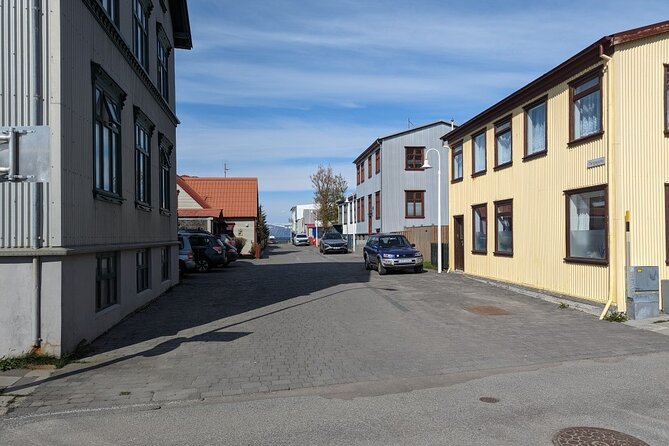
Sjúkrahúsið, the old hospital, adds an architectural pause to the route. Its well-preserved appearance helps explain why walking through Ísafjörður can feel rewarding even when you are not entering a museum or monument.
The building is part of the town’s visual story. Its appeal comes from age, shape, and setting, with the audio helping you notice more than you might on your own. You will not spend long here, but it is the kind of stop that gives the walk texture.
I like that the route does not focus only on famous attractions. An old hospital may not be the first place you search for in a new town, yet it can tell you how a community developed and what kinds of public buildings mattered. The limitation is that the experience offers no stated interior tour, so the value is mainly in the outside view and narration.
Jónsgarður and the Whalebone Arch
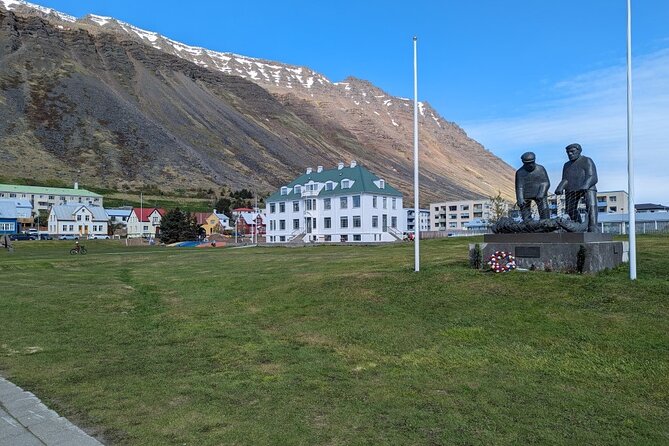
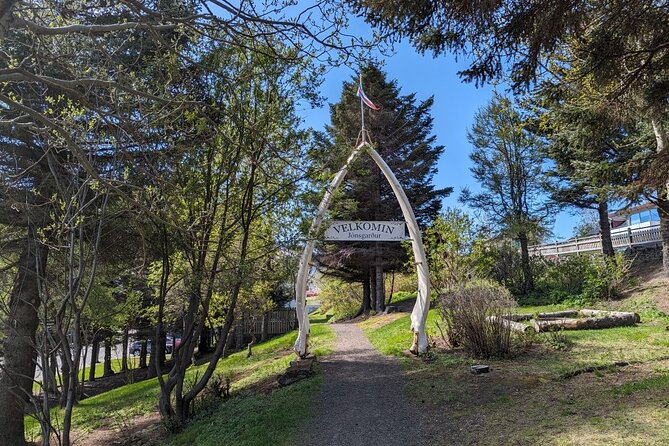
Jónsgarður park is a good place to slow down. The green space gives you a break from the streets, and the Whalebone Arch provides the most obvious photo opportunity on the route.
The arch also fits the larger theme of the walk: Ísafjörður’s close relationship with the sea. It is a physical reminder that marine life and maritime work have shaped local stories, public art, and town spaces.
Plan to pause here rather than simply pass through. You can take photographs, rest for a moment, and let the audio finish before moving on. Since the tour is self-guided, you are not holding up a group while you do so.
The Fishermen’s Monument
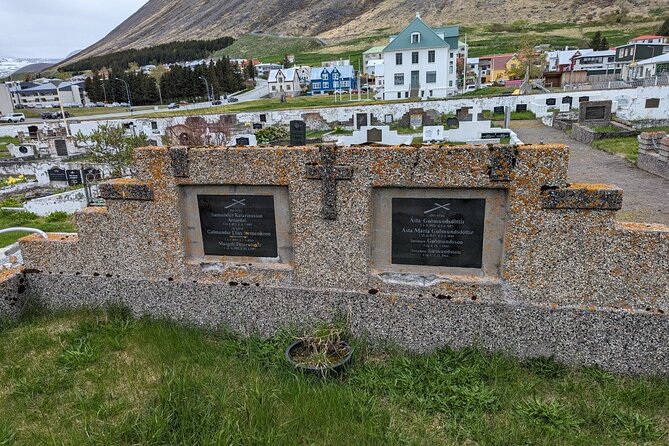
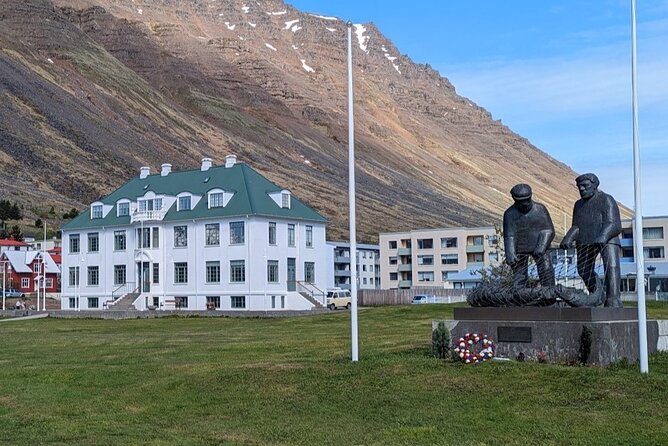
The large bronze Fishermen’s Monument honors the fishing community and the seafarers who helped the town prosper. It is a more direct expression of local pride than the quieter old buildings earlier in the walk.
The monument carries emotional weight because fishing was not easy or safe work. The route uses it to bring the maritime story into the present, connecting the museum’s historical material with a public work of art that anyone can see.
This is a good stop for listeners who want context, not just architecture. You can look closely at the sculpture while the narration explains why the subject matters. It also gives the tour a clear sense of place, since the monument belongs to Ísafjörður rather than being a generic attraction found in any Icelandic town.
The 3D Crosswalk and Ísafjörður’s playful side
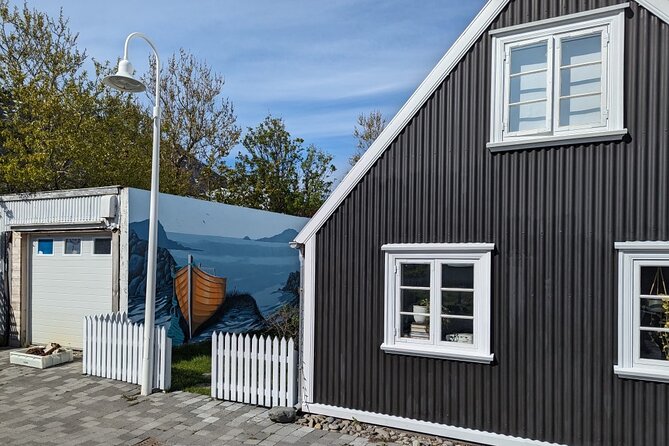
The 3D Crosswalk changes the tone. Designed to look as though its white stripes are floating above the road, it adds a playful piece of street art to a walk otherwise filled with churches, museums, monuments, and older buildings.
You will probably want a photograph here, but use care around traffic and respect the road as a working street. The stop is quick, yet it proves the town is not locked in the past. Ísafjörður can honor fishermen and preserve old architecture while also making room for visual tricks and modern public art.
This is one of the easiest stops to enjoy without advance knowledge. The effect is clear as soon as you see it, while the audio supplies the local context.
Culture House Eyrartún and local creative work
The route then passes Culture House Eyrartún, a venue where local artists show their work. This stop adds a contemporary cultural note and broadens the tour beyond maritime history.
You may be able to appreciate the building from outside, while any exhibition visit depends on access and opening arrangements. Entrance fees to museums or other attractions are not included, so keep that in mind if you decide to go inside.
I value this stop because it points you toward local creativity rather than treating Ísafjörður as a place you only observe. A town is more than its old houses and historic industries. Its artists also help explain how residents see their home now.
Austurvöllur garden, politics, and a famous volcano
Austurvöllur garden offers another calm pause. The garden has a connection to the town’s president and to an infamous volcano, linking a small public space with both political and natural history.
That combination is typical of the route. You are not given one narrow story about Ísafjörður. Instead, the walk moves between public figures, religious customs, working life, art, and Iceland’s volcanic character.
The garden is also useful late in the walk because you can pause without needing to buy anything or enter a building. If you have already spent time inside the museum or another attraction, this open-air stop helps keep the final part relaxed.
Finishing at Silfurtorg town square
The walk ends at Silfurtorg, at Aðalstræti 27, the town square. This is a natural finish because you arrive at the center of local life rather than being left at an isolated sight.
Use the square as a place to decide what comes next. You can stop the tour there, continue exploring independently, or return to a building that caught your attention earlier. The route does not include a meal, shopping, or additional activity, so any further plans are yours.
The ending also makes the tour practical for a short port call or a limited stay. You get a structured introduction, then finish in a central area where you can continue at your own pace.
How the VoiceMap app performs in practice
The audio is designed to start as you reach each location, using GPS. That makes the walk feel natural when everything works. You can keep your phone in hand or pocket, listen through headphones, and follow the map without needing a printed guide.
The setup deserves attention. Download the VoiceMap tour before you arrive, check that your location services are working, and make sure the audio plays correctly. Two people using different iPhone settings can end up out of sync, which creates confusion at the beginning.
GPS can also behave unpredictably. Construction or sanding work may force you onto different streets, and the app may not immediately understand the change. The useful backup is manual playback, which lets you start a stop yourself instead of abandoning the walk.
Offline access to the audio, maps, and geographic data is a major advantage in a place where a dependable connection cannot be assumed. Still, offline does not mean you can skip preparation. Download everything in advance and bring charged phones and headphones.
Who gets the best value for $9.99
At $9.99 per person, this is inexpensive for a 75 to 90-minute introduction, particularly because the purchase includes unlimited lifetime use. You can listen before your booking date, after it, or use the virtual playback option away from Ísafjörður.
The value is strongest for you if you have only a few hours, want local context, or dislike fixed group schedules. It is also useful for couples and families who walk at different speeds. You can pause for photos, enter a museum if you choose, or stop for a break without losing the rest of the group.
The price does not cover museum or attraction admission, and you supply the phone and headphones. Those are reasonable conditions, but include them in your planning. You are paying for the route, narration, GPS guidance, maps, and repeat access, not a live guide or a package of paid admissions.
The experience is available in English only. Most people can take part, and service animals are allowed. The provided information does not promise a fully accessible route, so if mobility is a major concern, ask for current route details before booking.
Who should book this walk?
Book it if you want a friendly introduction to Ísafjörður that mixes serious subjects with odd, memorable details. The personal narration, the story of Kerecis, the pancake connection at Ísafjarðarkirkja, and the Whalebone Arch give you more than a basic town orientation.
It is also a good choice if you value independence. You can take the walk in your own group, stop whenever you like, and reuse the audio later. Just prepare the app first and accept that GPS may need a little help.
Skip it if you need a live guide, guaranteed technical simplicity, or included entry to the Westfjord History Museum and other sites. For most independent visitors with a free hour or two, though, $9.99 is a fair price for a local, flexible walk that makes Ísafjörður easier to understand.
FAQ
How long does the Ísafjörður audio tour take?
The tour takes approximately 1 hour and 15 minutes to 1 hour and 30 minutes.
Where does the tour start?
It starts at the Westfjord History Museum, 400 Ísafjörður, Iceland.
Where does the tour end?
It ends at Silfurtorg, the town square, at Aðalstræti 27, 400 Ísafjörður.
What language is the tour offered in?
The tour is offered in English.
Do I need to bring anything?
You need to bring your own smartphone and headphones. Download the VoiceMap audio, map, and location data before starting.
Are museum tickets included?
No. Tickets or entrance fees for museums and other attractions along the route are not included.
Can I cancel for a full refund?
Yes. You can cancel at least 24 hours before the experience start time for a full refund. Cancellations or changes made less than 24 hours before the start time are not accepted for a refund.
Just added around Iceland
- Akureyri: Whale Watching Shore Excursions★ 4.6 · 250 reviews
- Reykjavik: Whale and Puffin Watching RIB Boat Tour★ 4.6 · 179 reviews
- Akureyri: Whale Watching Tour & Forest Lagoon Entrance★ 3.8 · 4 reviews
- Reykjavik: Whale Watching Express★ 4.3 · 227 reviews
- Reykjavik: Whale Watching & Lava Show★ 5.0 · 4 reviews
- West Glacial River Family Rafting★ 5.0 · 9 reviews
- Reykjavik: Whale & Marine Adventure Tour★ 4.3 · 71 reviews
- From Reykjavík: Viking Horseback Tour in Hafnarfjörður★ 4.9 · 112 reviews
Self-Guided Tours, compared.

South Coast Iceland from Reykjavik with Guide & Touchscreen Audio
Read our review →
Hellisheiði Geothermal Exhibition: Entry and Audio Tour
Read our review →
Reykjavik Main Sights and Hidden Spots: A Self-Guided Audio Walk
Read our review →

Reykjavik Scavenger Hunt and Highlights Self Guided Audio Tour
Read our review →
Icelands Reykjavik Self Guided Walking Audio Tour
Read our review →

Reykjanes Peninsula: Volcanos & Blue Lagoon Self-Guided Tour
Read our review →Browse the lists this tour appears in